
World’s poorest children missing out on pre-primary education

New analysis for sa国际传媒 warns of a chronic lack of funding by global leaders听Less than 1% of the global education aid budget goes to pre-primary education听8 of the world鈥檚 top 30 donors听to education听give nothing to pre-primary education
Eight in 10 of the world鈥檚 poorest children 鈥� almost 50 million boys and girls – are missing out on vital education in the first few years of their life because of a chronic lack of funding in pre-primary education, according to a new report published today.听
听
Spending on pre-primary education accounts for less than 1% of the international community鈥檚 aid to education – equivalent to just 34 cents per child, per year – according to analysis by Cambridge University academics for sa国际传媒, the global children鈥檚 charity.听
Research shows that pre-primary education is crucial to a child’s development and that children who miss out on early years learning fall behind even before they start primary school. Children enrolled in at least one year of pre-primary education are more likely to develop critical skills and are less likely to drop out of school.听
Yet spending on pre-primary education remains consistently low, with donors on average committing 37 times more to post-secondary education, the analysis shows.听
Of the world鈥檚 top 30 donors to education, eight do not spend a single cent on pre-primary education, including the Netherlands, Qatar, Sweden and Saudi Arabia.听听
The US, France, Denmark and Germany are among the 16 countries that commit less than 0.5% of their education aid budget to pre-primary education. The UK devotes 1.1%, closely behind Italy (1.8%), Belgium (1.9%), the Czech Republic and South Korea (2.2%). See graph below.听
听
Of all donor countries, only UNICEF and the Global Partnership for Education, one of the major funds for education in lower-income countries, meet sa国际传媒鈥檚 recommended target of investing at least 10% education aid budgets in pre-primary education. They are followed by Education Cannot Wait, a dedicated fund for crisis situations (8.6%), and New Zealand (6.7%). The World Bank is next, but some way behind (3.8%).听
The report –听听– analyses data submitted by international donors to the OECD鈥檚 Development Assistance Committee Creditor Reporting System. The most up to date figures are from 2019 so reflect investment before the Covid-19 pandemic.听听
The analysis shows that the proportion of aid spent on pre-primary education has been increasing – but from a very low base, increasing between 2015 and 2019 from just 0.8% to 0.9%, the highest level since records began.听
The report concludes that 6.4 million more children a year in low-income countries would benefit from pre-primary education if donors stepped up and met sa国际传媒鈥檚 recommended 10% target.听听
Investing in pre-primary education pays off. According to one estimate, for every dollar put into early childhood care and education, world leaders can expect a dividend of $17 in return.听听
Professor Pauline Rose, director of the Research for Equitable Access and Learning (REAL) Centre, University of Cambridge, and one of the report鈥檚 authors, said international donors need to wake up.听
鈥淭he first five years of a child鈥檚 life are among the most critical for their long-term development and the benefits of investing in pre-primary education are found to be the greatest for the most disadvantaged,鈥� she said.听
鈥淚t is nothing short of a tragedy that world leaders are failing to prioritise spending in this area. The international community must wake up and step up. Without urgent action, the risk is that some of the world鈥檚 poorest and most marginalised will continue to fall behind.鈥�
Sarah Brown, Chair of sa国际传媒, said:听鈥淐ovid-19 has exacerbated the global education crisis and pushed the world鈥檚 poorest children further to the margins. We cannot let this continue.听听
鈥淥ver the next 12 months, world leaders have a series of opportunities at high level meetings, where global stimulus plans will be developed, to show their commitment to the provision of quality pre-primary education.鈥澨�
Justin van Fleet, President of sa国际传媒, said:听“We know that funding pre-primary education is the most important and impactful thing world leaders can do to give children around the world the best start in life and to put economies back on track following the pandemic.听
鈥淭hanks in part to our campaigning, progress has been made – but it鈥檚 not enough. It鈥檚 time for world leaders to walk the walk and invest 10% of their education aid budgets to the early years. Anything less is a failure for the world’s children.鈥澨�
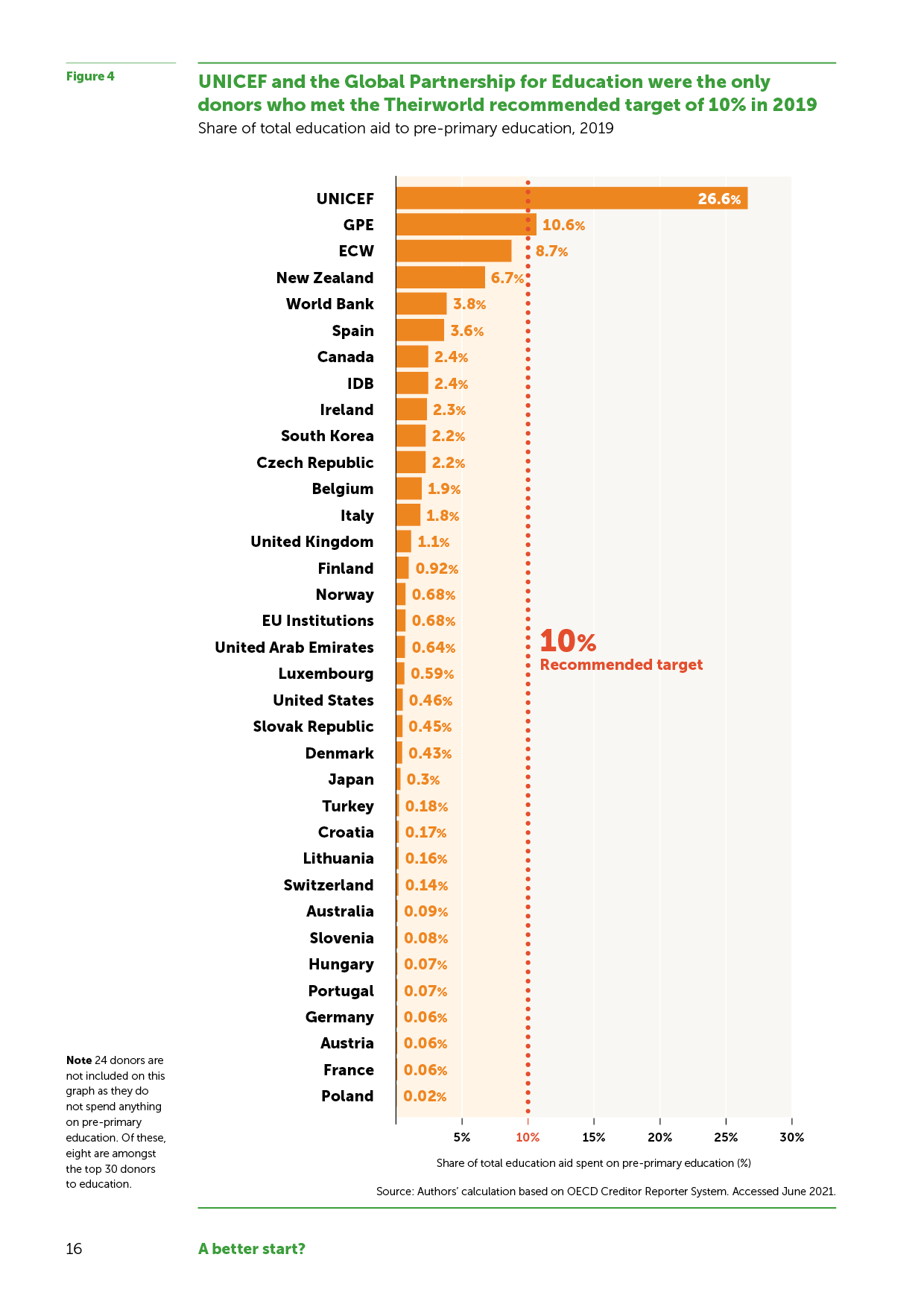 Note: 24 donors are not included on this graph as they do not spend anything on pre-primary education. Of these, eight are amongst the top 30 donors to education.
Notes to Editors听听听
For further enquiries, please contact:听听
Nicole Martin听
Head of Partnerships and Media听
Mob: 07768 695 087听
Email:听nicole@theirworld.org听
About sa国际传媒听
sa国际传媒 is a global children鈥檚 charity committed to ending the global education crisis.听听
It anticipates, targets and solves the complex barriers keeping children and young people from education and opportunity. The organisation mobilises the power of campaigning, policy change and innovation to provide every child, especially the most marginalised, with the best start in life, a safe place to learn and skills for the future.听听
Informed by breakthrough research and activated by an influential network of partners, sa国际传媒 works with governments, businesses, NGOs, young people and campaigners to develop and deploy solutions to unleash the potential of the next generation.听听
For more information, visit www.theirworld.org. Twitter @theirworld.听
About the REAL Centre听
The Research for Equitable Access and Learning (REAL) Centre is part of the Faculty of Education, University of Cambridge. The Centre pioneers research into overcoming barriers to education, such as poverty, gender, ethnicity, language and disability, and promotes education as an engine for inclusive growth and sustainable development.听
The Centre applies rigorous research methods, drawing together the Faculty鈥檚 strengths in development conceptualising, measuring and analysing education inequalities, and in identifying the pathways through which excellence and equality in education transforms societies. It works in partnership with organisations and individuals in priority countries, jointly defining, planning, implementing and analysing the research in ways that contribute to joint publications. And it ensures impact by linking evidence with policy at a national and global level.听
听听